Tuesday, May 31, 2011

Types of fishes...


Here are some different fish we saw at Pidgon Key...


Sergent Major
Bermuda Chub
Barracuda


Blue Tang
French Grunt
Angel Fish
Yellowtail Snapper
Southern Sting-Ray
Tarpon 


Hag Fish 
Nurse Shark
Mangrove Snapper
Trumpet Fish
Porcupine Fish
Rainbow Parrotfish
Stoplight Parrot Fish


Bluestriped Grunt
Gray Snapper
Porkfish
Silversides
Blue Tang


Worksheet...


Tuesday, May 24, 2011

Motion in the Ocean part 2


Take "The End" back. So tides are under the influence of the sun and the moon... the moon is closer, therefor has more gravitational pull. The sun is farther away, so it has less pull...
Oh, and Neap tides are smaller (because the sun and moon are pulling in opposite directions) while Spring tides are larger because the moon and sun are pulling in the same direction.

Current:

There are shallow currents (influenced by land masses and winds) and are used by ships to sail around the world. The shallow currents are circular, and in a specific area (separated by land mass). The currents spin; clockwise in the Northern Hemisphere, and counterclockwise in the Southern Hemisphere. There is not current in the equator... called a doldrum. 


There are also deep currents (aka thermohaline) (influenced by salt and temperature) which is all the water in the world. Heard of "Global Conveyor Belt"? Yeah, that has to do with deep currents. In this, the cold water (as usual) sinks, along with the salt water (as usual) (hot water goes up, then cools down, then sinks...)


There is the Hadley Cell, where at the Equator, hot air goes up, then goes down. Coriolis Effect makes the it that when the hot air goes up, then goes down, it does not come back in the same place. This then makes little loops around the equator.


Motion in the Ocean

Today we played with wave tables (and yesterday, cause it took us so long). We learned that waves are caused by wind (we also said whales caused waves...) The waves then cause erosion, ect, ect (thats why you shouldn't build a hotel on a barrier reef).

So, after putting together the wave table, we first set up a "reflection." We did this by putting a barrier at an angle to the incoming waves, making the waves hit the surface and bounce off (at a consistent angle).
Then we made a "refraction" by sticking a shape under the water, making the waves bend as they travel over the objects. Note: waves bend because of water properties. As the wave goes over something, the water molecules stick to whatever surface their going over. Then the water molecules stick to the bottom molecules... all of this slowing each other down (the bottom is the slowest, the top is the fastest) (thats what makes a wave that comes on the shore).
Lastly, there was "diffraction," which is how a wave changes when passing through two objects.


The end!

Monday, May 23, 2011

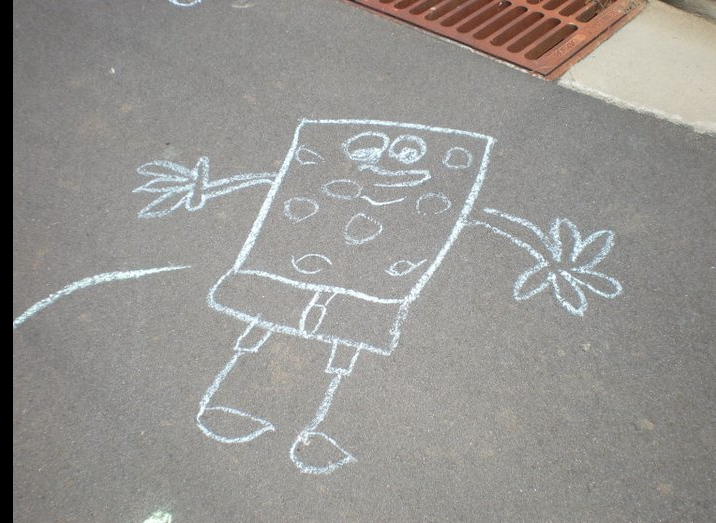
Ecology and Chalk...

So yesterday we went out and brain dumped about food webs and all by drawing any marine animals...


We learned about autotrophs (consumers, eat things) and heterotrophs (producers, make their own food). 


Under autotrophs, there are: chemiautotrophs make their own food using chemicals, and photoautotroph make their food using sunlight.


Under heterotrophs, there are: carnivores (eat meat), omnivores (eat everything) and herbivores (eat grass).


There are also eukaryotic (multicellular) and prokaryotic (one-cellular).


A food web is with organisms eating each other... in a "logical pattern."


So here are the pics of our food web... :D


Photosynthesis

CO2 + H20 -> C6H12O6 + O2
Thats the equation for photosynthesis. 

Chlorophyll helps photosynthesis happen; and chlorophyll has many pigments: green (majorly), red, blue, yellow, orange...

To make photosynthesis start, you need light (red, orange, yellow, green, blue, indigo, violet = white)


Green plants use most white light except green (that's why the plant is green).

-If a green plant is put in green light, then it will not do much photosynthesis (hypothesis).


In the ocean, light penetrates, right? So red, orange, yellow and purple goes out the first (which is what normal green plants use).  Blue goes the deepest (that's why the ocean is blue) (Blue penetrates and reflects the deepest). Therefor, because there isn't red or yellow or orange light, plants need to be a different color (not-green) to absorb the light. And thats why deeper algae is brown.


Friday, May 20, 2011

Coral Reefs, Deep Sea Vents, Estuaries...

If you want to see the other half of the  "reflections," visit this link: 
http://marinebiologyintersession.blogspot.com/


(done by my partner & BFF)

Cobble Beaches


OK, so yesterday, when our teacher was like "Hey, were going to observe cobble beaches today," I was 

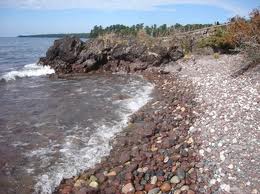
like "Whaaat????" cause I have NO idea what cobble beaches are. Period. So, when we finally got to our mysterious cobble beach, I was actually surprised to learn that I already basically knew what a cobble beach is. Really, its a beach with a bunch of pebbles (for sand) and that hurts to step on.


Cobble Beaches are formed by glaciers, who "drive" through, and leave rocks behind.
 
We saw many organisms, like sea lettuce, rock weeds, sugar kelp, periwinkle, mussels, dogwinkle, barnacles, beach fleas, shrimp, herring gulls, black-winged gulls, rock crabs, sea anemones...


This unique, with it's rocky beaches, are found in some Maine shorelines, in the upper West Coast (Washington, Oregon...) 


Well, tired from the trip, but it was wonderful and I'm happy I now now the real name for "rocky beaches"...